

Collateral Management for Financial Institutions
Date: 21st January 2027
Venue: DoubleTree by Hilton Kuala Lumpur
Classroom Training
COURSE INTRODUCTION
Effective collateral management has become a strategic priority for banks operating in increasingly complex funding, liquidity, and regulatory environments. Financial institutions are expected not only to mitigate counterparty credit risk effectively, but also to optimize collateral usage across treasury, liquidity, derivatives, and financing activities while maintaining strong governance and operational controls.
This intensive 1-day course has been designed for practitioners from both conventional and Islamic banks. The course provides a practical and strategic understanding of collateral management across its full lifecycle, covering collateral usage in repo and secured funding transactions, derivatives and counterparty credit risk management, treasury liquidity management, and the regulatory capital treatment of collateral. The course also explores how Islamic banking structures influence collateral management practices. Particular attention is given to Shariah-compliant collateral (Rahn), the use of Sukuk as eligible collateral, and restrictions on rehypothecation and collateral usage. In addition to core operational workflows such as margining, settlement, reconciliation, and dispute handling, the course introduces delegates to collateral optimization techniques and practical decision-making frameworks. Numerical examples are used extensively to demonstrate competing collateral demands, opportunity costs, and liquidity considerations.
The course combines conceptual explanations with practical examples, worked numerical illustrations, and interactive discussion. Delegates will work through collateral optimization examples demonstrating the trade-offs between funding cost, liquidity preservation, and the impact of haircuts. Examples and discussions will include both conventional and Islamic banking perspectives to ensure relevance across the Malaysian banking sector. The course is highly practical and interactive, blending conceptual understanding with worked examples and case studies relevant to treasury, risk management, financing teams and collateral management practitioners.
Key Takeaways & Learning Objectives
- Understand the economic purpose and strategic importance of collateral management
- Learn how collateral supports treasury funding, liquidity, and counterparty credit risk mitigation
- Understand margining mechanics, collateral eligibility, and haircuts
- Explore collateral optimization techniques using practical numerical examples
- Understand regulatory capital requirements for collateral
- Learn how collateral practices differ in Islamic banks due to Shariah requirements
AGENDA
Session 1: Foundations of Collateral Management
- What is collateral and why is it important?
- Economic purpose of collateral and credit risk mitigation
- Overview of the collateral lifecycle
- Collateral calls, allocation, settlement, reconciliation, and reporting
- Key risks: credit, liquidity, legal, operational, and valuation risk
- Collateral usage across treasury, derivatives, secured funding, and corporate banking
- Roles and responsibilities across treasury, risk, operations, legal, and compliance
- Overview of bilateral and triparty collateral structures
- What is Bank Negara’s position on collateral management?
Session 2: Margining, Haircuts, and Operational Processes
- Exposure measurement and collateral valuation
- Thresholds, Minimum Transfer Amounts (MTAs), and call frequency
- Margin call workflow: calculation, validation, communication, and settlement
- Collateral substitution and dispute management
- Operational controls, reconciliations, and exception handling
- Operational challenges in treasury and derivatives collateral management
Session 3: Collateral Optimization and Treasury Applications
- What is collateral optimization?
- Competing collateral demands across treasury, derivatives, liquidity, and financing
- Managing collateral under liquidity and funding constraints
- Opportunity cost, haircut cost, and liquidity-buffer impact
- Optimization decision framework and allocation strategies
- Numerical optimization examples using cash, government Sukuk, and corporate Sukuk
Session 4: Islamic Banking Considerations
- Shariah recognition of collateral (Rahn)
- Key Shariah requirements and restrictions on collateral usage and rehypothecation
- Collateralization in Murabahah, Ijarah, Salam, and Istisna transactions
- Collateralization of Islamic risk management and hedging structures
- Use of Sukuk as eligible collateral
Session 5: Collateral Management and Regulatory Capital
- Regulatory objectives
- Overview of regulatory treatment of collateral
- Simple versus Comprehensive approaches for collateral recognition
- Haircuts and partial collateralization
- Capital relief examples and collateral impact on risk weighted assets
Course Wrap-up
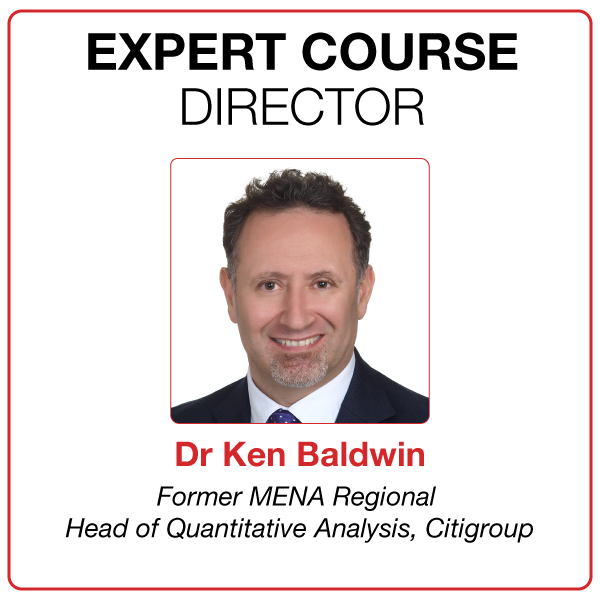
EXPERT COURSE DIRECTOR

Dr. Ken Baldwin has worked as a practitioner in banking and finance for over 25 years in senior positions spanning the front and middle offices. Having graduated from Oxford University with a first-class honors degree in Physics in 1989, he qualified as a Chartered Accountant with PWC, before joining UBS, and then later Credit Suisse, in derivatives risk and control functions based in London.
He gained a PhD in microeconomics and worked in the GCC for 15 years in retail and investment banks. Whilst at Abu Dhabi Islamic Bank, Dr. Ken built an ALM analytic technology platform capable of capturing liquidity and interest rate risks inherent in the many varied financing products used at retail and corporate levels. He then moved to take up the position of MENA Regional Head of Quantitative Analysis for Citigroup. At Citicorp, Dr. Ken worked on structuring complex derivatives products used by Gulf-regional corporations to hedge FX and interest rate risks. Still residing in Bahrain, Dr. Ken then joined Investcorp, where he worked on the risk due diligence of corporate private equity and real estate private equity transactions and portfolio management. After leaving Investcorp, he set up the risk management department for venture capital bank, providing Basel III compliance and deal analysis for the bank. He then operationalized a new Islamic investment bank as its Chief Operating Officer for 3 years, before his most recent industry role at the Islamic Development Bank, where he set up and ran a new department tasked with developing financial policies and risk-based pricing of the bank’s Islamic financing products. Dr. Ken is currently an Assistant Professor of Finance in the UK. He has published quantitative finance articles in peer-reviewed academic journals including the Journal of International Financial Markets Institutions and Money, the Journal of Risk, and Economics Letters, and during his earlier career, taught CFA and FRM professional certifications as a pastime for the Bahrain Institute of Banking and Finance.
WHO WILL BENEFIT?
- This course has been designed for practitioners involved in collateral management, treasury, treasury operations, risk, and financing functions. Professionals most likely to directly benefit from the course include:
- Treasury and liquidity management professionals
- Collateral management and margining teams
- Repo and secured funding practitioners
- Market and counterparty credit risk managers
- Treasury operations and settlements teams
- Regulatory capital specialists
- Custody and collateral operations teams
- Compliance and internal audit professionals
- Central bank regulators and supervisors
REGISTRATION

FEE
Fee per participant: RM3,250/US$850
Please note that the Ringgit price is applicable to Malaysia-domiciled participants only. Discounts are available for group bookings. Please contact us for more details.

Send me Details
IN-HOUSE/GROUP TRAINING
If you are looking for an in-house training program or wish to send a group to an existing public program, kindly please contact Andrew Tebbutt at [email protected] or +603 2162 7802.
Learn More
Contact us