

Fixed Income Markets & Products for Financial Institutions
Date: 18th & 19th January 2027
Venue: DoubleTree by Hilton Kuala Lumpur
Classroom Training
WHY THIS COURSE?
The annual growth of bond issuances in Asia over the last two decades exceeds 20% p.a., five times the global average (International Capital Market Association, March 2025). Most of this growth has been led by China, with growing issuance volumes for both bank and non-bank corporations. In addition to the rapid regional growth in fixed income markets, the prevalence of bonds denominated in foreign currencies (e.g., RMB) and the appearance of new bond types, e.g., Green bonds and Social bonds, point to a pressing need for investment bankers, portfolio managers, financial analysts, and risk managers to strengthen their technical capabilities to understand and effectively use fixed income instruments in real-world scenarios. This need is further compounded by an increasingly volatile global economy, not least due to international trade wars and tariff uncertainties.
This comprehensive two-day course equips participants with an understanding of fixed income analytics and a knowledge of advanced strategies to construct and manage fixed income portfolios whilst hedging risks with confidence. Participants will explore the strategic applications of various bond types, understand the mechanics of bond pricing, bond yields, and bond duration, and learn how to interpret credit ratings and economic indicators for portfolio decision-making. The course also explains how derivatives such as using interest rate swaps, options, credit default swaps (CDS) and Total Return Swaps (TRS) are applied to manage interest rate and credit risks to achieve target portfolio risk-adjusted returns.
The course is highly interactive and makes widespread use of illustrations and numerical examples to aid understanding. It also provides ample opportunity for delegates to ask questions and gain important knowledge to implement actionable insights to effectively manage fixed income portfolios.
Learning Objectives & Takeaways:
- Develop a strong foundation in fixed income analytics, including pricing, yield and duration analysis.
- Interpret key market indicators, including the yield curve, credit ratings, and macroeconomic variables to make informed investment and capital raising decisions.
- Gain hands-on experience in using fixed income derivatives for interest rate and credit risk hedging requirements, including immunizing bond portfolios against interest rate risk.
AGENDA
Day One: Fixed Income Mechanics and Bond Pricing
Overview of Products, Markets and Regulation
- Who are the main issuers and investors in fixed income instruments?
- Types of fixed income instruments explained: treasury securities, bond futures, structured notes, commercial paper, medium-term notes, inflation-linked notes, and zero-coupon bonds
- How do bonds come into existence?
- What is the process for trading and settling bond transactions in the primary and secondary markets?
- How does liquidity differ in the primary and secondary bond markets?
- Who regulates the fixed income markets and what are the key regulatory objectives?
- What is the role of external credit rating agencies and why are institutional investors still required to internally assess credit risk for capital adequacy purposes?
- Why are inflationary expectations and the economic cycle so important to the bond markets?
Pricing and Risk Analytics for Bonds and Fixed Income Portfolios
- Understanding bond pricing and yield to maturity
- What is duration and convexity?
- How is risk measured at a portfolio level for fixed income instruments?
- When are summary risk metrics less useful and what are the risk measurement alternatives?
- What role do bond yields play in the term structure of interest rates?
- How can the term structure of interest rates be modelled for risk purposes?
- Explaining the composition of ‘credit spreads’: liquidity versus credit risk
Case Study: Pricing and risk analytics for a corporate bond issuance
Day Two: Derivative Products and Hedging Strategies
Applying Complex Products: Interest Rate Derivatives
- Forward rate agreements (FRAs) and interest rate swaps (IRSs)
- Interest rate options: caps, floors, and swaptions
- Futures on bonds and bond indices
- Options on bonds and bond futures
Managing Credit Risk with Credit Derivatives and Related Products
- How do credit derivatives help manage default risk?
- Credit default swaps (CDSs)
- Total return swaps (TRSs)
Immunizing a Bond Portfolio against Interest Rate Risk
- What are immunization techniques and how are they applied to bond portfolios?
- Parallel yield curve shifts
- Non-parallel yield curve shifts
Understanding Regulatory Frameworks, Clearing, and Counterparty Credit Risk
- Exchange-traded products
- OTC products
- Credit valuation adjustment (CVA)
- Collateralization
Case Study: Designing a derivatives hedging strategy for a fixed income portfolio using interest rate swaps
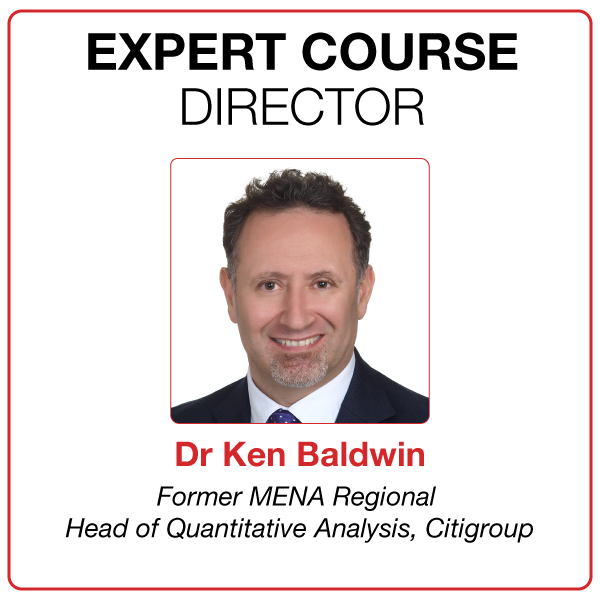
EXPERT COURSE DIRECTOR

Dr. Ken Baldwin has worked as a practitioner in banking and finance for over 25 years in senior positions spanning the front and middle offices. Having graduated from Oxford University with a first-class honors degree in Physics in 1989, he qualified as a Chartered Accountant with PWC, before joining UBS, and then later Credit Suisse, in derivatives risk and control functions based in London.
He gained a PhD in microeconomics and worked in the GCC for 15 years in retail and investment banks. Whilst at Abu Dhabi Islamic Bank, Dr. Ken built an ALM analytic technology platform capable of capturing liquidity and interest rate risks inherent in the many varied financing products used at retail and corporate levels. He then moved to take up the position of MENA Regional Head of Quantitative Analysis for Citigroup. At Citicorp, Dr. Ken worked on structuring complex derivatives products used by Gulf-regional corporations to hedge FX and interest rate risks. Still residing in Bahrain, Dr. Ken then joined Investcorp, where he worked on the risk due diligence of corporate private equity and real estate private equity transactions and portfolio management. After leaving Investcorp, he set up the risk management department for venture capital bank, providing Basel III compliance and deal analysis for the bank. He then operationalized a new Islamic investment bank as its Chief Operating Officer for 3 years, before his most recent industry role at the Islamic Development Bank, where he set up and ran a new department tasked with developing financial policies and risk-based pricing of the bank’s Islamic financing products. Dr. Ken is currently an Assistant Professor of Finance in the UK. He has published quantitative finance articles in peer-reviewed academic journals including the Journal of International Financial Markets Institutions and Money, the Journal of Risk, and Economics Letters, and during his earlier career, taught CFA and FRM professional certifications as a pastime for the Bahrain Institute of Banking and Finance.
WHO WILL BENEFIT?
- This course has been specifically designed for the benefit of:
- Chief executive officers
- Chief risk officers
- Chief financial officers
- Financial risk managers and risk analysts
- Treasury analysts and market risk managers
- Credit risk managers and analysts
- Credit managers
- Credit administrators
- Corporate bankers
- Retail bankers
- Internal auditors
- Compliance officers
- Supervisors, regulators and risk standard setters
REGISTRATION

FEE
Fee per participant: RM6,500/US$1,750
Please note that the Ringgit price is applicable to Malaysia-domiciled participants only. Discounts are available for group bookings. Please contact us for more details.

Send me Details
IN-HOUSE/GROUP TRAINING
If you are looking for an in-house training program or wish to send a group to an existing public program, kindly please contact Andrew Tebbutt at [email protected] or +603 2162 7802.
Learn More
Contact us