Interest Rate Risk in the Banking Book (IRRBB): Measurement, Stress Testing & Balance Sheet Strategy
Date: 20th & 21st July 2026
Venue: DoubleTree by Hilton Kuala Lumpur
Classroom Training
WHY THIS COURSE?
Interest Rate Risk in the Banking Book (IRRBB) is once again a critical driver of bank resilience, profitability, and regulatory scrutiny amid volatile rate environments and shifting customer behaviour. This intensive two-day public training programme in Kuala Lumpur equips senior banking professionals with a practical, end-to-end understanding of IRRBB, covering measurement (EVE, NII, sensitivities), behavioural modelling, governance, stress testing, hedging strategies, and ALCO decision-making. Blending Malaysian regulatory expectations with global lessons from recent bank failures and digital banking case studies, the course goes beyond theory to focus on real balance sheet challenges. Through interactive simulations and ALCO role-plays, participants learn how to interpret IRRBB outputs, challenge assumptions, and translate risk insights into sound strategic actions that strengthen earnings stability, capital resilience, and balance sheet performance across interest rate cycles.
Learning Objectives and Key Takeaways
- By the end of this course, participants will be able to:
- Understand the drivers and measurement of IRRBB, including key metrics and behavioural assumptions.
- Assess IRRBB exposures using EVE, NII and sensitivity tools, with awareness of limitations.
- Build and evaluate behavioural models for deposits, term funding and prepayment-sensitive assets.
- Design and interpret IRRBB stress tests, integrating results into ICAAP and capital strategies.
- Evaluate hedging strategies and understand their ALCO-level implications.
- Diagnose IRRBB vulnerabilities through real case studies and Pillar 3 disclosures.
- Use simulation-based decision making to optimise balance sheet risk-return trade-offs.
AGENDA
DAY 1: Foundations, Measurement & Behavioural Modelling
- Types and sources of IRR in the banking book
- How IRR arises from gaps, repricing and option behaviour
- Banking book vs trading book distinctions
- Assessing the impact of shifting rate environments
- IRRBB governance, RMF, RAS and ALCO responsibilities
- The three pillars of ALM optimisation
- Positioning IRRBB within broader balance sheet strategy
- How ALCO uses IRRBB insights to steer profitability and risk
- Lessons from US S&Ls, UK pension LDI crisis, Silicon Valley Bank
- Case Study: IRRBB vulnerabilities in Japanese banks
- Key metrics: ΔNII, EVE, DV01, Earnings-at-Risk
- Interpretation, limitations and model risk
- Hedging strategies used by banks (practical overview)
- Modelling non-maturity deposits (core, beta, elasticity)
- Term deposit redemption behaviour (TDRR)
- Loan prepayments and conditional prepayment rates (CPR)
- Why behavioural assumptions dominate IRRBB outcomes
- Understanding publicly disclosed IRRBB information
- Benchmarking Malaysian banks, regional peers and global banks
- Emerging use cases for AI in IRRBB measurement and forecasting
- Global and Malaysian examples
- Case Studies: Digital bank interest rate risk; IRRBB risks in Bank D
- How policy shifts reshape balance sheet structure and business models
- Implications for NII stability, EVE sensitivity and capital planning
DAY 2: Stress Testing, Hedging & Strategic ALCO Decision-Making
- Embedding IRRBB within ICAAP and capital planning
- Early warning indicators and supervisory expectations
- Setting and monitoring RAS-aligned limits
- Developing meaningful rate-shock and rate-path scenarios
- Standardised vs internally developed approaches
- Managing limit breaches and escalation triggers
- Case Studies: IRRBB lessons from recent Malaysian and global cycles
- Structural vs tactical hedging decisions
- Managing fixed-rate and floating-rate exposures
- Practical Malaysian hedging instruments (MGS/MGII overlays, IRS, options)
- When hedge accounting matters from an ALCO viewpoint
- Participants act as ALCO members
- Interpreting IRRBB positions and proposing strategic actions
- Balancing constraints: earnings, capital, liquidity, customer behaviour
- Analysing balance sheet resources and constraints
- Identifying emerging IRRBB risks and margin pressure points
- Deploying strategies and observing their effect on ROE, NII and limits
- Consolidating insights into a practical IRRBB improvement roadmap
- Discussion of implementation challenges in Malaysian institutions
- Closing reflections and action plans
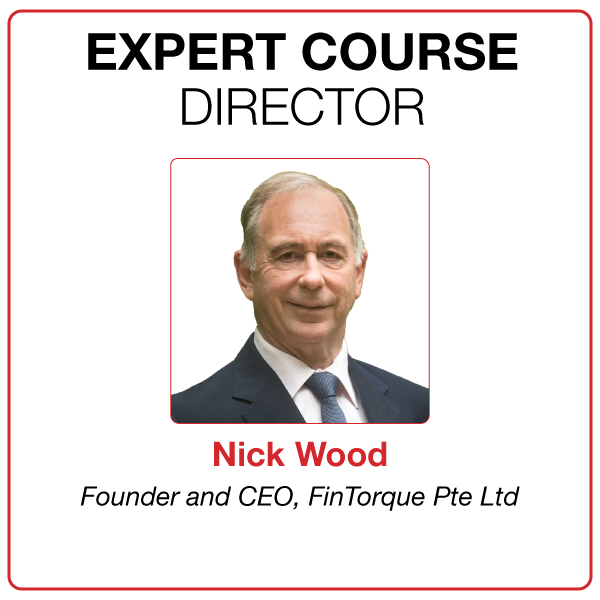
EXPERT COURSE DIRECTOR
Nick Wood is the founder and CEO of FinTorque Pte Ltd, a financial services consulting company and co-founder, and director of Augury Insights a Singapore fintech company specialising in balance sheet modelling. He has extensive experience in training large business groups on ALCO effectiveness and balance sheet optimisation and is a regular speaker at industry events on treasury topics. Nick was recently the Financial Sector Consultant for the International Monetary Fund (IMF), where he provided specialist advice on impact of regulatory reforms on banks and financial stability in Asia and the Emerging Markets and contributed towards the IMF Global Financial Markets Stability Report. He has been a bank treasury expert for 38 years, of which more than 27 years were spent in Asia, where he built highly profitable trading floors, conducted entity business reviews and has first-hand balance sheet management experience during market crises and idiosyncratic stress across large banking groups. His former roles included Head of Business Treasury, Head of Liquidity Management, Head of Funds Transfer Pricing Policy and ALM Business Planning Manager.
WHO SHOULD ATTEND?
- This programme is designed for senior officers and key personnel with responsibilities for interest rate risk management, balance sheet risk oversight, and capital adequacy assessment, including those involved in ALCO deliberations and ICAAP processes. It is particularly relevant for officers from:
- Treasury/Asset–Liability Management (structural interest rate risk, balance sheet positioning, liquidity and funding strategy, investments).
- Risk Management (market risk, IRRBB, stress testing, model risk management, ICAAP)
- Finance (Funds Transfer Pricing, financial planning, capital management, earnings and profitability analysis).
- ALCO Secretariat and Balance Sheet Committees.
- Digital Banking and Business Units (product pricing, behavioural assumptions, new business models and rate sensitivity).
- Strategy and corporate planning.
- Internal audit and independent review functions.
- Regulatory reporting and compliance.
- The programme is suitable for institutions subject to BNM’s Risk Management in Financial Institutions and Capital Adequacy Framework requirements, including conventional and digital banks.
REGISTRATION
FEE
Fee per participant: RM6,500/US$1,750
Please note that the Ringgit price is applicable to Malaysia-domiciled participants only. Discounts are available for group bookings. Please contact us for more details.


Send me Details
IN-HOUSE/GROUP TRAINING
If you are looking for an in-house training program or wish to send a group to an existing public program, kindly please contact Andrew Tebbutt at [email protected] or +603 2162 7802.
Learn More
Contact us