

Enhancing Shariah Governance and Compliance Culture for Financial Institutions
Date: 26th October 2026
Venue: DoubleTree by Hilton Kuala Lumpur
Classroom Training
COURSE BACKGROUND
This one-day professional development programme is designed to strengthen participants’ understanding of Shariah governance and compliance culture within Islamic financial institutions. The course explores how sound governance frameworks, clear roles and responsibilities, and an ethical culture aligned with Shariah principles form the foundation for sustainable Islamic finance. Through interactive discussions, real-world examples and group exercises, participants will learn practical approaches for embedding effective governance structures, cultivating organisational integrity, and integrating Shariah compliance into all aspects of institutional decision-making and behaviour.
Strong Shariah governance and compliance culture are essential to safeguard public confidence in Islamic finance. Beyond policies and controls, institutions must nurture values of accountability, trust and excellence. This training addresses both structural and cultural dimensions of Shariah governance, enabling leaders and employees alike to align business objectives with Shariah requirements, enhance operational integrity, and mitigate non-compliance risk. The programme is relevant across all levels of Islamic financial institutions, emphasising that Shariah culture must be championed from the top and lived throughout the organisation.
- Key learning Objectives and Takeaways:
- Explain the key principles and components of effective Shariah governance frameworks.
- Distinguish the respective roles of the Board, Shariah Committee, and Management in governance and internal control.
- Describe the functions and inter-relationships of Shariah review, audit, and risk management.
- Identify practices that build and sustain a strong Shariah compliance culture across the institution.
- Apply practical tools and behavioural approaches to strengthen compliance accountability and organisational integrity.
AGENDA
Session 1: Shariah Governance, Culture & Internal Control
- Overview of Shariah governance and internal control frameworks
- Current regulatory and institutional expectations
- Roles and responsibilities of the Board, Shariah Committee, and Management
- Strengthening accountability and independence in decision-making
- Linking Shariah governance with organisational culture and values
- Promoting a culture of Shariah compliance and ethical behaviour
- Open discussion and Q&A
Session 2: Shariah Governance and Control Functions
- Understanding Shariah governance control functions
- Roles and interrelationships of Shariah review, audit, and risk management
- Internal Shariah Audit Framework – purpose, structure, and importance
- Practical considerations in establishing effective governance mechanisms
- Reporting lines and maintaining functional independence
- Common gaps and challenges in implementation
- Building and sustaining a compliance-oriented culture
- Group mapping exercise: ‘Governance Roles in Our Institution’
- Group Q&A and reflections
Session 3: Building an Effective Shariah Compliance Culture
- Shariah compliance culture: concepts and significance
- Developing internal policies and initiatives that reinforce Shariah values
- Setting the tone from the top: leadership and management commitment
- HRM’s role in embedding ethics, training, and incentives
- Addressing behavioural biases and ethical decision-making
- Integrating governance and culture across business and support functions
- Managing and reporting Shariah non-compliance risk
- Role-play and discussion: ‘Tone from the Top in Practice’
Session 4: Workshop & Wrap-Up
- Reflection on key learnings from the day
- Sharing of institutional improvement ideas
- Summary discussion and closing remarks
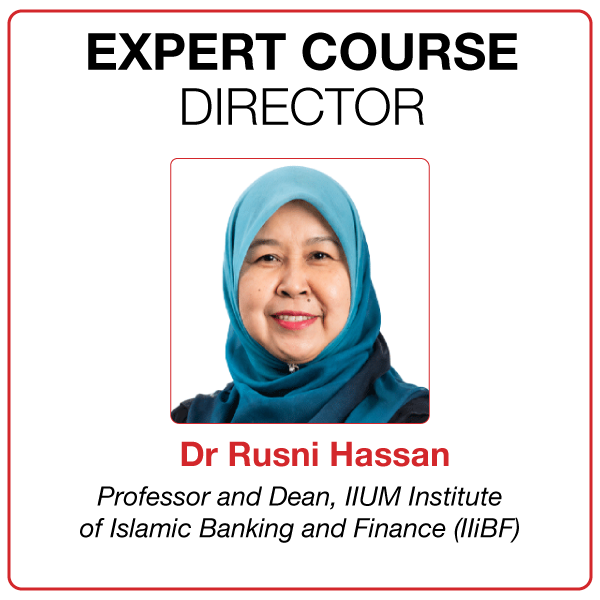
EXPERT COURSE DIRECTOR

Prof Dr Rusni Hassan is a Professor at the IIUM Institute of Islamic Banking and Finance (IIiBF), International Islamic University Malaysia (IIUM), and a globally recognised authority in Islamic banking and finance. With nearly 30 years of academic and industry experience, she specialises in Shariah, governance, and the legal aspects of Islamic banking and finance. A distinguished researcher and expert trainer, she has authored numerous books, book chapters, and articles in leading local and international journals, and is recognised among the Top 10 contributors to Islamic finance research in the Scopus database. Beyond academia, she serves as Chairman and member of Shariah Committees, as well as a Board Director of Islamic financial institutions in Malaysia and internationally. Her exceptional contributions to the industry have earned her international recognition, including being named among the Top 10 Most Influential Women in Islamic Business and Finance by Cambridge IFA for seven consecutive years (2019–2024). In 2025, she was honoured with the Islamic Finance Personality of the Year award by the Global Islamic Finance Awards (GIFA), followed by the Takaful Kembara Award 2026 by the Malaysian Takaful Association in recognition of her longstanding contributions to strengthening Shariah governance, advancing industry practices, and nurturing talent within the Islamic banking and finance sector.
WHO SHOULD ATTEND?
- This course is designed for a broad cross-section of Islamic financial institution personnel, including:
- Board members and Shariah committee members
- Senior and middle management
- Shariah, compliance, risk management and internal audit officers
- Product development, operations and support staff
- Support and enabling functions (e.g., HR, legal, finance)
REGISTRATION

FEE
Fee per participant: RM2,600/US$700
Please note that the Ringgit price is applicable to Malaysia-domiciled participants only. Discounts are available for group bookings. Please contact us for more details.

Send me Details
IN-HOUSE/GROUP TRAINING
If you are looking for an in-house training program or wish to send a group to an existing public program, kindly please contact Andrew Tebbutt at [email protected] or +603 2162 7802.
Learn More
Contact us