Fee per participant: RM6,500/US$1,750
Please note that the Ringgit price is applicable to Malaysia-domiciled participants only. Discounts are available for group bookings. Please contact us for more details.


Date: 3rd & 4th September 2026
Venue: DoubleTree by Hilton Kuala Lumpur
Classroom Training
The Global Financial Crisis of 2007–09 provided a powerful reminder of the critical importance of Funds Transfer Pricing. Many banks entered the crisis with inadequate internal pricing of funding and liquidity, weak incentives at the business-unit level, and limited transparency over where interest rate and liquidity risks truly resided. Institutions that lacked robust FTP frameworks found it difficult to manage funding stress, assess true profitability, or align business decisions with balance-sheet constraints.
Today, FTP is recognised as a core internal discipline, not only for managing funding, liquidity, and interest rate risk, but also for accurate product pricing, performance measurement, capital allocation, and incentive alignment. Regulators increasingly expect banks to demonstrate that FTP frameworks are well-designed, consistently applied, and embedded in governance, risk appetite, and ALM decision-making.
For financial institutions operating in Malaysia, FTP must also be understood in the context of Bank Negara Malaysia’s supervisory expectations. This includes alignment with BNM’s prudential standards on liquidity risk, interest rate risk in the banking book, internal capital adequacy assessment processes, and broader balance-sheet governance. FTP is a key mechanism through which these regulatory objectives are translated into day-to-day business decisions.
This intensive 2-day course provides clear, practical, and implementation-focused instruction in FTP concepts, curve construction, and applications, aligned with current best practice. The programme makes extensive use of illustrations, worked examples, and case studies to connect theory with real-world banking practice. A highly interactive format encourages participants to engage directly with the material, clarify challenges specific to their institutions, and gain deeper insight into how FTP supports both regulatory compliance and commercial performance.
Key Learning Objectives & Takeaways
Case Study: Northern Rock
Case Study: Detailed FTP example
Case Study: Managing non-maturing liabilities in the matched-maturity framework
Case Study: Calculating profitability and return on equity

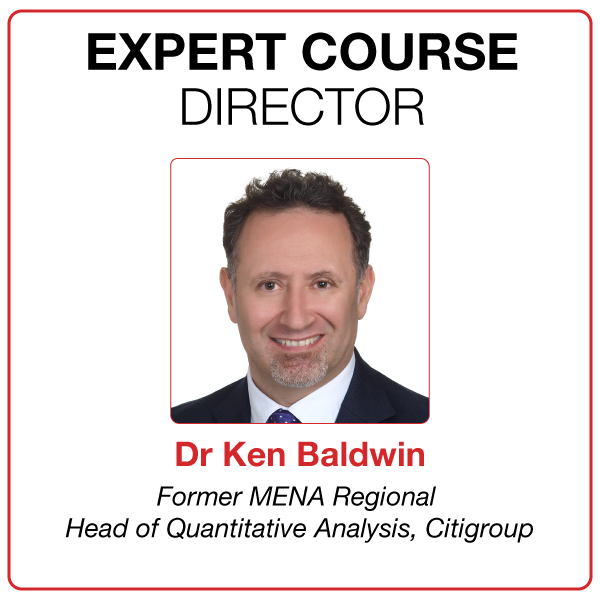
Dr. Ken Baldwin has worked as a practitioner in banking and finance for over 25 years in senior positions spanning the front and middle offices. Having graduated from Oxford University with a first-class honors degree in Physics in 1989, he qualified as a Chartered Accountant with PWC, before joining UBS, and then later Credit Suisse, in derivatives risk and control functions based in London.
He gained a PhD in microeconomics and worked in the GCC for 15 years in retail and investment banks. Whilst at Abu Dhabi Islamic Bank, Dr. Ken built an ALM analytic technology platform capable of capturing liquidity and interest rate risks inherent in the many varied financing products used at retail and corporate levels. He then moved to take up the position of MENA Regional Head of Quantitative Analysis for Citigroup. At Citicorp, Dr. Ken worked on structuring complex derivatives products used by Gulf-regional corporations to hedge FX and interest rate risks. Still residing in Bahrain, Dr. Ken then joined Investcorp, where he worked on the risk due diligence of corporate private equity and real estate private equity transactions and portfolio management. After leaving Investcorp, he set up the risk management department for venture capital bank, providing Basel III compliance and deal analysis for the bank. He then operationalized a new Islamic investment bank as its Chief Operating Officer for 3 years, before his most recent industry role at the Islamic Development Bank, where he set up and ran a new department tasked with developing financial policies and risk-based pricing of the bank’s Islamic financing products. Dr. Ken is currently an Assistant Professor of Finance in the UK. He has published quantitative finance articles in peer-reviewed academic journals including the Journal of International Financial Markets Institutions and Money, the Journal of Risk, and Economics Letters, and during his earlier career, taught CFA and FRM professional certifications as a pastime for the Bahrain Institute of Banking and Finance.

Fee per participant: RM6,500/US$1,750
Please note that the Ringgit price is applicable to Malaysia-domiciled participants only. Discounts are available for group bookings. Please contact us for more details.

Send me Details
If you are looking for an in-house training program or wish to send a group to an existing public program, kindly please contact Andrew Tebbutt at [email protected] or +603 2162 7802.
Learn More
Contact us