

Capital Management and ICAAP for Financial Institutions
Date: 8th September 2026
Venue: DoubleTree by Hilton Kuala Lumpur
Classroom Training
WHY THIS COURSE?
Equity capital is the most precious financial resource a bank possesses. It underpins financial resilience, supports target credit ratings, lowers funding costs, and enables a bank to absorb unexpected losses while continuing as a going concern. In practice, strong capital management is not just a regulatory requirement—it is a strategic capability that directly influences profitability, growth, and stakeholder confidence.
Yet, capital is frequently mismanaged. Even well-established institutions are not immune. In 2024, the Australian regulator required ANZ Bank to raise an additional A$250 million due to weak risk governance and deficiencies in bond trading activities. Earlier, in 2017, the world’s oldest bank, Banca Monte dei Paschi di Siena, required recapitalisation following poor capital management and risky financial strategies. These cases highlight a clear lesson: capital adequacy alone is not enough, and capital must be actively and intelligently managed.
-
This highly interactive one-day course equips banking practitioners with the practical knowledge and regulatory insight needed to manage equity capital effectively while remaining fully compliant with Basel IV requirements. Participants will learn how capital must be managed both:
- On a static basis, to meet minimum capital adequacy ratios, and
- On a forward-looking basis, through the effective development and application of an ICAAP (Internal Capital Adequacy Assessment Process).
Crucially, the course goes beyond compliance. Given the substantial resources required to build and maintain an ICAAP, participants will learn how to extract real business value from it, including its use in pricing financial instruments, allocating equity capital efficiently, supporting credit rating outcomes, and guiding future business strategy.
The course is fully aligned with the supervisory expectations of Bank Negara Malaysia, with a strong emphasis on understanding local regulatory requirements, supervisory review processes, and practical compliance within the Malaysian banking environment. No prior knowledge of Basel regulations is assumed.
Key Learning Objectives and Takeaways
-
By the end of the course, participants will be able to:
- Gain a thorough and practical understanding of compliance with minimum capital adequacy requirements under Basel IV
- Develop and implement an effective ICAAP that meets regulatory expectations and achieves internal buy-in
- Clearly distinguish between regulatory capital and economic capital, and understand their implications for decision-making
- Use the ICAAP as a strategic management tool, supporting:
- Product pricing
- Capital allocation
- Credit rating objectives
- Forward business planning
- Strengthen engagement with supervisors through a clearer understanding of Bank Negara Malaysia’s capital and ICAAP expectations
AGENDA
Basel IV Capital and Leverage: Regulatory Requirements and Practical Implications for Banks
- Minimum capital requirements
- How do capital tiers economically differ and why has tier-3 been abolished?
- Contingent convertibles and what they mean for capital planning
- Essential Pillar 2 risks:
- Interest rate risk in the banking book
- Concentration risk
- Capital conservation buffer
- Countercyclical capital buffer
- Leverage ratio
- Additional capital requirements for Islamic banks
ICAAP: From Regulatory Requirement to Strategic Capital Management Tool
- The purpose of ICAAP
- What goes into an ICAAP?
- Relationship between ICAAP, ILAAP, and stress-testing
- Current and future capital requirements
- Challenges to ICAAP adoption
- The differences between regulatory and economic capital
- How to use the ICAAP effectively
- Pricing financial instruments
- Setting the level of future business
- Credit rating exercise
- Capital allocation
- How ICAAP differs between conventional and Islamic banks
- The role of output floors in capital planning
Course Review and Wrap-up
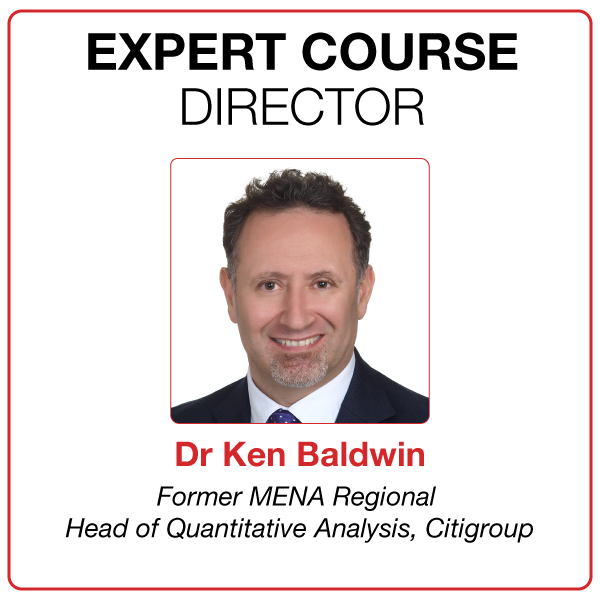
EXPERT COURSE DIRECTOR

Dr. Ken Baldwin has worked as a practitioner in banking and finance for over 25 years in senior positions spanning the front and middle offices. Having graduated from Oxford University with a first-class honors degree in Physics in 1989, he qualified as a Chartered Accountant with PWC, before joining UBS, and then later Credit Suisse, in derivatives risk and control functions based in London.
He gained a PhD in microeconomics and worked in the GCC for 15 years in retail and investment banks. Whilst at Abu Dhabi Islamic Bank, Dr. Ken built an ALM analytic technology platform capable of capturing liquidity and interest rate risks inherent in the many varied financing products used at retail and corporate levels. He then moved to take up the position of MENA Regional Head of Quantitative Analysis for Citigroup. At Citicorp, Dr. Ken worked on structuring complex derivatives products used by Gulf-regional corporations to hedge FX and interest rate risks. Still residing in Bahrain, Dr. Ken then joined Investcorp, where he worked on the risk due diligence of corporate private equity and real estate private equity transactions and portfolio management. After leaving Investcorp, he set up the risk management department for venture capital bank, providing Basel III compliance and deal analysis for the bank. He then operationalized a new Islamic investment bank as its Chief Operating Officer for 3 years, before his most recent industry role at the Islamic Development Bank, where he set up and ran a new department tasked with developing financial policies and risk-based pricing of the bank’s Islamic financing products. Dr. Ken is currently an Assistant Professor of Finance in the UK. He has published quantitative finance articles in peer-reviewed academic journals including the Journal of International Financial Markets Institutions and Money, the Journal of Risk, and Economics Letters, and during his earlier career, taught CFA and FRM professional certifications as a pastime for the Bahrain Institute of Banking and Finance.
WHO WILL BENEFIT?
- This course is specifically designed for professionals involved in capital, risk, finance, treasury, and regulatory oversight, including:
- Chief executive officers
- Chief risk officers
- Chief financial officers
- Financial risk managers and analysts
- Treasury analysts and market risk managers
- Credit risk managers and analysts
- Credit managers
- Credit administrators
- Corporate bankers
- Retail bankers
- Internal auditors
- Compliance officers
- Supervisors, regulators and risk standard setters
REGISTRATION

FEE
Fee per participant: RM3,250/US$850
Please note that the Ringgit price is applicable to Malaysia-domiciled participants only. Discounts are available for group bookings. Please contact us for more details.

Send me Details
IN-HOUSE/GROUP TRAINING
If you are looking for an in-house training program or wish to send a group to an existing public program, kindly please contact Andrew Tebbutt at [email protected] or +603 2162 7802.
Learn More
Contact us