

Accounting and Financial Reporting for Islamic Financial Structures under IFRS
A Two-Day Advanced Training Program
Date: 27th & 28th July 2026
Venue: DoubleTree by Hilton Kuala Lumpur
Classroom Training
TRAINING PURPOSE & INTRODUCTION
This two-day advanced training program is designed to provide participants with a rigorous, practical understanding of how International Financial Reporting Standards (IFRS) apply to Shariah-compliant financial structures. It addresses the critical challenge faced by Islamic financial institutions: aligning the economic substance of Islamic contracts with IFRS recognition, measurement, and presentation requirements.
The program bridges the gap between technical accounting standards and the unique features of Islamic finance, enabling participants to confidently interpret, apply, and report Islamic financial transactions in line with IFRS and international best practices. Emphasis is placed on judgment areas where Islamic structures interact most intensively with IFRS, including classification, revenue recognition, expected credit losses, consolidation, and disclosure.
Highly practical and application-driven, the workshop uses real-world examples, case studies, and hands-on analysis. Participants will gain deep insights into IFRS 9 Financial Instruments, IFRS 15 Revenue from Contracts with Customers, and IFRS 16 Leases, with focused coverage on Murabaha, Ijarah, Mudarabah, Musharakah, Salam, Istisna’, Wakalah, and Sukuk structures. By the end of the program, participants will be better equipped to address regulator expectations, audit scrutiny, and complex reporting decisions in an Islamic finance environment.
Learning Objectives & Key Takeaways
- By the end of this program, participants will be able to:
- Apply IFRS principles to Islamic financial contracts, aligning Shariah-based structures with recognition, measurement, and presentation requirements under IFRS.
- Classify and measure Islamic financial instruments under IFRS 9, including SPPI assessments, business model evaluation, and Expected Credit Loss application.
- Apply IFRS 15 and IFRS 16 to Islamic transactions, addressing revenue recognition for Islamic contracts and lease accounting for Ijarah arrangements.
- Assess accounting and reporting implications of Sukuk structures, including consolidation, fair value measurement, and disclosure requirements.
- Exercise informed professional judgment in areas of substance-over-form, regulatory expectations, audit scrutiny, and complex Islamic finance structures.
- Translate technical IFRS requirements into practical reporting decisions through real-world case studies and integrated applications.
AGENDA
Day 1 Agenda
Session 1: IFRS Conceptual Framework & Relevance to Islamic Finance
- Overview of the IFRS Conceptual Framework
- Measurement, recognition and presentation principles
- Shariah principles and their interaction with IFRS
- Substance-over-form vs. contractual form in Islamic Finance
- Challenges faced by Islamic institutions under IFRS
Session 2: Core Islamic Contracts & Impact of IFRS
- Murabahah: Effective Yield Method vs Markup Revenue Recognition vs Amortized cost
- Ijarah: Operating vs Finance lease under IFRS 16
- Mudarabah: Equity vs liability classification under IFRS 10 and IAS 32
- Musharakah: Joint arrangements vs Partnership vs Financing under IFRS 11 and IFRS 9
- Salam & Istisna’: Contract assets under IFRS 15
- Wakalah: Fee recognition under IFRS 15
Session 3: IFRS 9 – Classification, Measurement & Expected Credit Losses (ECL)
- Solely Payments of Principal and Interest (SPPI) test for Islamic contracts
- Business model assessment for Islamic banks
- Applying ECL models to Islamic products
- ECL model inputs considerations for non-interest-bearing instruments
Session 4: IFRS 15 – Revenue Recognition
- Applying the 5-step model to Islamic instruments
- Revenue timing differences (cashflow vs IFRS)
Day 2 Agenda
Session 5: Sukuk Structures & IFRS Implications
- Types of Sukuk: Ijarah, Murabahah, Wakalah, Musharakah, Hybrid
- IFRS 9 classification and measurement of Sukuk investments
- Special Purpose Vehicle (SPV) consolidation under IFRS 10
- Disclosure requirements under IFRS 12
Session 6: Other Standards - IFRS 16, IFRS 13 & IFRS 7
- Lease accounting and Ijarah structures
- Fair value measurement for Islamic financial instruments
- Key disclosure requirements for Islamic banks
Session 7: Sustainability, Risk Management & Financial Reporting
- Shariah governance expectations on reporting
- Risk exposures in Islamic finance
- IFRS Sustainability Reporting standards and alignment with Islamic Finance
- Financial statement presentation for Islamic institutions
Session 8: Integrated Case Study
- Assessment of Murabahah, Ijarah, Mudarabah, Musharakah, Sukuk
- IFRS classifications and revenue treatment
- Group presentation and review
Final Discussion and Wrap-up
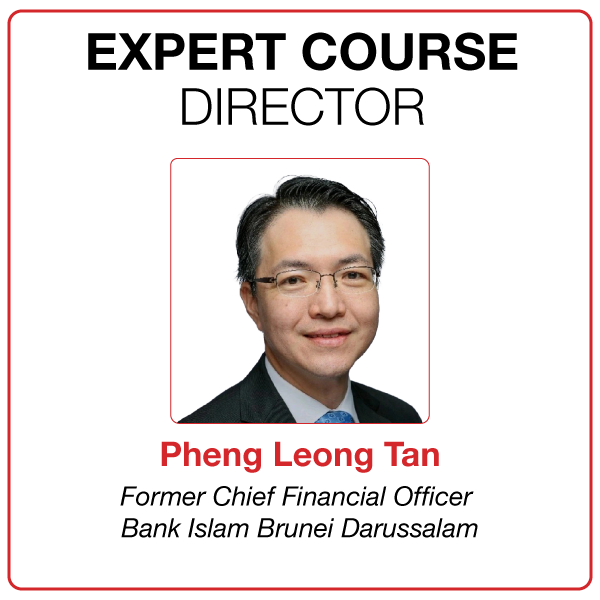
EXPERT COURSE DIRECTOR

Pheng Leong Tan has over 20 years of experience in financial reporting, IFRS implementation, and Islamic finance. He has advised banks, regulators, and corporates in the UK and Southeast Asia on technical accounting matters, financial instruments, and regulatory reporting. He previously served as Chief Financial Officer of the largest Islamic bank in Brunei and was a Partner at a big four accounting firm, where he led IFRS advisory and audit engagements for financial institutions, including Islamic banks. Pheng Leong has delivered technical IFRS and financial reporting training to CFOs, financial controllers, auditors, and compliance professionals. He is a regular speaker at finance and accounting conferences and has been involved in IFRS implementation projects across both conventional and Islamic financial institutions. His experience spans IFRS 9, IFRS 15, IFRS 16, financial instruments, consolidation, and Islamic finance contracts, with a focus on practical application and regulatory-aligned reporting.
WHO WILL BENEFIT
- This program is intended for professionals with prior IFRS knowledge who are involved in Islamic finance and financial reporting, including:
- Finance managers, financial controllers, and CFOs in Islamic financial institutions.
- Financial reporting, technical accounting, and IFRS implementation teams.
- Internal and external auditors covering Islamic financial institutions.
- Risk management and credit professionals involved in IFRS 9 and ECL.
- Shariah governance and compliance professionals seeking deeper accounting insight.
- Regulators and supervisory staff overseeing Islamic financial institutions.
- Treasury, investment, and Sukuk structuring professionals.
- Prerequisite: To benefit from this program, participants should have a working knowledge of IFRS.
REGISTRATION

FEE
Fee per participant: RM6,500/US$1,750
Please note that the Ringgit price is applicable to Malaysia-domiciled participants only. Discounts are available for group bookings. Please contact us for more details.

Send me Details
IN-HOUSE/GROUP TRAINING
If you are looking for an in-house training program or wish to send a group to an existing public program, kindly please contact Andrew Tebbutt at [email protected] or +603 2162 7802.
Learn More
Contact us